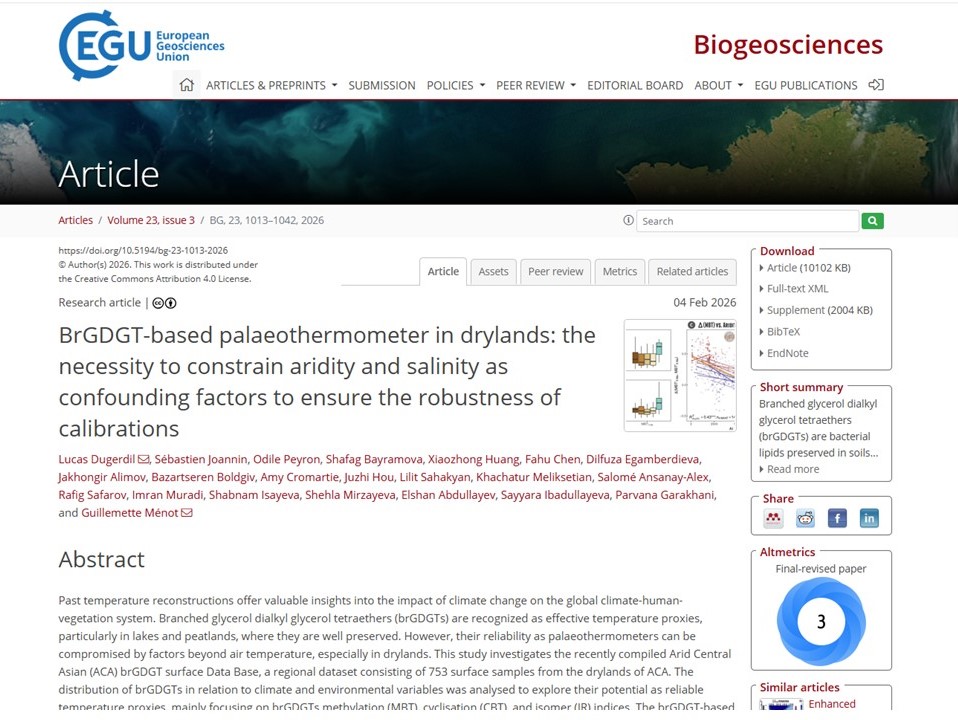
Accurate reconstruction of past temperatures in arid climatic conditions is of great importance for studying the impact of climate change on the nature-human-plant system. The results of a new international study in this field have been published in the high-impact, Q1-ranked scientific journal Biogeosciences.
In the article titled “BrGDGT-based paleothermometer in drylands: the necessity to constrain aridity and salinity as confounding factors to ensure the robustness of calibrations”, co-authored by researchers of the Institute of Botany PLE of the Ministry of Science and Education of the Republic of Azerbaijan together with international colleagues, the issue of temperature reconstruction in arid zones has been extensively investigated.
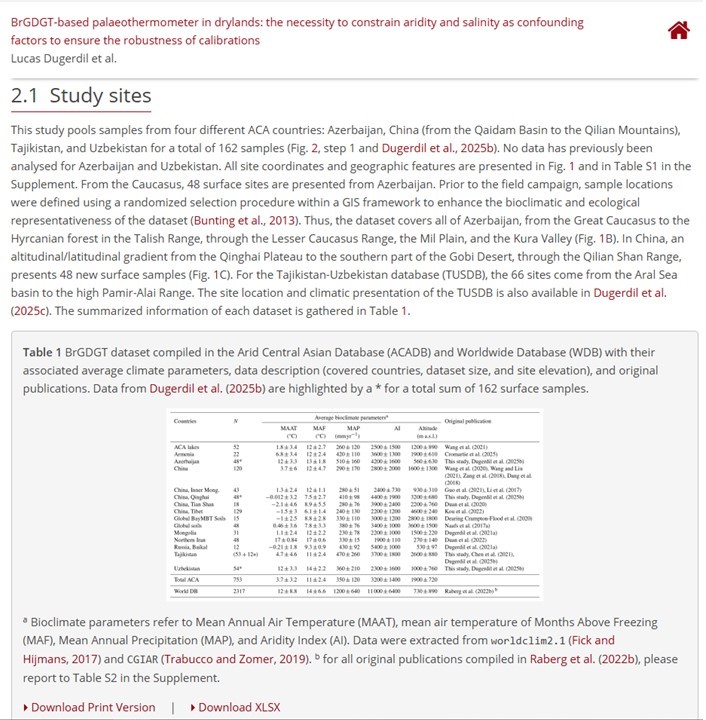
It should be noted that, within the framework of the study, a joint international research team conducted a 23-day expedition in the territory of Azerbaijan together with staff of the Institute of Botany PLE. Soil and plant samples were collected from various areas and included in the overall analysis.
The research showed that while brGDGTs are a promising tool for temperature reconstruction, their signals in arid regions depend not only on temperature but also on several additional factors. Salinity was identified as the primary influencing factor. In addition, the type of environment (soil or lake sediments), pH level, and degree of aridity also play significant roles. The interaction of these factors particularly leads to distortion of temperature signals in lacustrine environments.
The study further found that certain indices-especially those related to salinity and pH are more reliable for assessing the physicochemical properties of environments. At the same time, the use of specifically calibrated models for different ecological conditions significantly improves the accuracy of temperature reconstructions.
According to experts, the obtained results enable further refinement of paleoclimate models. Moreover, the study is considered an important scientific contribution to a deeper understanding of the adaptation mechanisms of plant and soil systems formed under extreme conditions.
https://doi.org/10.5194/bg-23-







1791958830.jpg)





1730190904.jpg)