| Place of birth | Quba town, Azerbaijan | 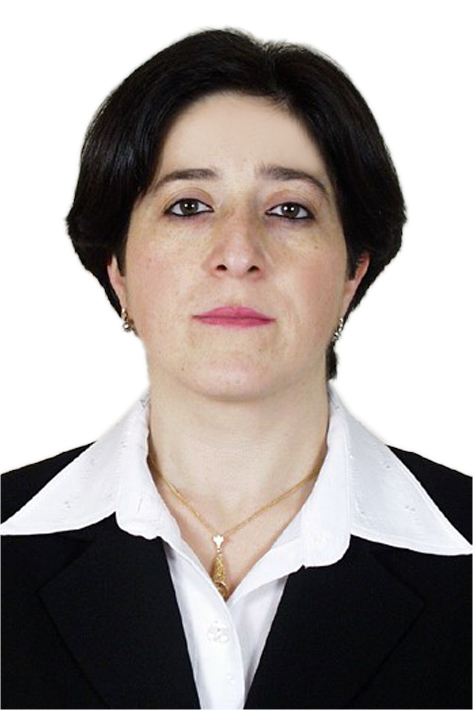 |
| Date of birth | 05 June, 1968 | |
| Education | Baku State University, faculty of biology | |
| Scientific degree | Doctor of Biological Sciences | |
| Title | Professor | |
| Topic of PhD thesis: - specialty code - specialty name - topic name |
03.00.05 (currently 2417.01) Botany “Biology of the fungi causing tracheomycosis of wood plants” | |
| Topic of doctoral thesis: - specialty code - specialty name - topic name |
2430.01 Mycology “Fungi associated with forest trees, taxonomy and phylogeny of pathogenic species” | |
| Total number of printed scientific publications:
| 187 | |
| - number of scientific publications printed abroad: | 82 | |
| - number of papers published in journals indexed and abstracted in international databases | 40 | |
| Number of patents and certificates of authorship | ||
| Staff training: - number of PhD - number of Doctor of sciences | 2 | |
| Basic scientific achievements | Agayeva Dilzara Nadir has been a Candidate of Biological Sciences (currently a Doctor of Philosophy) in the specialty "Botany" since 1997 and a Doctor of Biological Sciences in the specialty "Mycology" in 2014, and was awarded the scientific title of Professor in the specialty "Mycology" in 2025. She specializes in the study of fungi associated with tree species, especially pathogenic fungi. In 2002-2003, she carried out a project titled “Taxonomy of ophiostomatoid fungi (Ascomycota) inhabiting various woody trees in Azerbaijan” as a PostDoc researcher at the University of Pretoria within the framework of a project of the National Science Foundation of South Africa [Aghayeva et al., 2004, 2005, Grobbelaar et al. 2009]. Later, she was the executor or leader of various projects in the direction of research on fungi that are the causative agents of plant diseases. She carried out an individual project entitled “Ultrastructural study of conidiogenesis in Tuberculina species and comparison of spermatia genesis in rust fungi” (2005) funded by the German Academic Exchange Service (DAAD) at the University of Tübingen, Germany [Aghayeva et al. 2006]. Her individual project “Current status of Ulmus spp. div. infected with Dutch elm disease and Castanea sativa showing symptoms of chestnut canker in Azerbaijan” (2005-2006) was awarded a prize by the UNESCO/Keizo Obuchi Research program [Aghayeva, Harrington 2008]. She was the leader of the interdisciplinary projects “Environmental safety: Monitoring of fungal associations and pathogens of some woody plants of Azerbaijan” (2006-2008) and “Molecular study of fungi associated with bark beetles (Coleoptera: Scolytidae) destroying pines in Azerbaijan” (2009-2010), funded by the Science and Technology Center in Ukraine (STCU). The projects were partially implemented in Azerbaijan and partially at the University of Iowa, USA. These projects were aimed at solving taxonomic problems of individual fungal species associated with plants and insects using morphological and molecular methods and investigating the phylogeny of pathogenic species. Based on the comparison of morphology, development in culture, reproduction type and DNA sequences, new species were described for science [Harrington et al. 2008, 2010, 2011]. In recent years, she has participated in the ecologically important projects “Cryphonectria parasitica canker and control of chestnut production in North Azerbaijan” (2011) funded by the Norwegian Humanitarian Organization operating in Azerbaijan. “Protection of biodiversity: assessment of the status of rare and endangered plant and fungal species of Azerbaijan” (EIF-2010-1(1)) and also she was the manager of the project entitled “Chestnut blight in Azerbaijan: study the population structure of the Cryphonectria parasitica (Murrill) M.E.Barr. and the effectiveness of transmissible hypovirulence for biological control” SDF (EIF-2013-9(15)-46/29/3-M-10) funded by the Science Development Foundation (SDF). Competitive international scholarship programs (DAAD, UNESCO), long-term collaborations on joint projects with Germany, USA, South Africa, Switzerland and Italy have opened up opportunities to conduct research in areas requiring DNA analysis, such as molecular systematics, population genetics. D.N. Aghayeva has participated in numerous international mycological and botanical conferences, congresses (IBC, IMC, ICPP) and other events (EPPO, FAO, ICCP, IUFRO) abroad and made presentations on relevant issues. The work carried out as the head of the Mycology Laboratory of the Institute of Botany Public Legal Entity combines two main research directions: (1) creation of a database containing the biodiversity and taxonomy, host plants and geographical distribution of micro- and macro-fungi; (2) research on plant pathogenic fungi, rare, endangered species and medicinally important fungi. A check list of powdery mildew fungi of Azerbaijan has recently been compiled, with 133 species described [Aghayeva, Abasova 2021]. More than 40 new fungal species have been recorded in recent years [Aghayeva et al. 2018, Mustafabeyli, Aghayeva, 2019, 2021]. Although research on macrofungi continues, new research studies are investigating the biologically active substances and antimicrobial properties of fungi [Yusifova et al. 2025; Alimammadova Hüsüyeva et al. 2025]. In recent years, against the backdrop of deteriorating climatic conditions and increasing anthropogenic impact, more attention has been paid to the fungi of the main forest-forming trees [Ağayeva 2023, Cornejo, Aghayeva, Beenken 2026]. | |
| Names of scientific works | Books:
Articles: Cornejo C., Aghayeva D., Beenken L. (2026) The tree-parasitic fungus Cryphonectria carpinicola discovered on European chestnut and European hornbeam in Azerbaijan. EPPO Bulletin, 56(1): 1–6. https://doi. org/10.1111/epp.70069 Haelewaters D., Aghayeva D., de-Miguel S., Degtjarenko P. et al. (2026) Mapping the landscape of mycological organizations in Europe: where citizen science meets professional mycology. Biodiversity and Conservation, 35 (37) https://doi.org/10.1007/s10531-025-03219-2 Yusifova Y., tul-Wahab A., Choudhary I.M., Siddiqui M., Khan N., Atif M., Zafer H., Aghayeva D.N. (2025) Laetiporus sulphureus mushroom culture - source of secondary metabolites and catalyst for biotransformation of breast cancer drug exemestane. Steroids, 221:109647. doi: 10.1016/j.steroids.2025.109647 Yusifova Y.A., Aghayeva D.N. (2025) Taxonomic composition of macromycetes of Goygol National Park ın Azerbaijan. Chornomorski Botanical Journal, 21 (1): 31–40. https://doi.org/10.32999/ksu1990- 553X/2025-21-1-2 Alimammadova Husuyeva A.A., Bısko N., Mytropolska N.Yu., Gurınovych N.V., Aghayeva D.N. (2025) Аntimicrobial activity in cultures of some xylotrophic basidiomycetes from Azerbaijan. Ukrainian Botanical Journal, 82 (3): 252-25. https://doi.org/10.15407/ukrbotj82.03 Aghayeva D.N. (2024) A checklist of Ascomycota found on forest trees and shrubs in Azerbaijan. Sydowia, 76: 71-93. Antonelli A., Teisher J.K., Smith R.J., Ainsworth A.M., Furci G., Gaya E., Gonçalves S.C., Hawksworth, D.L., Larridon I., Sessa E.B., Simões A-R.G., Suz L.M., Acedo C., Aghayeva D.N. et al. (2024) The 2030 Declaration on Scientific Plant and Fungal Collecting. Plants, People, Planet. DOI: https://doi.org/10.1002/ppp3.10569 Marco F., Navarro B., Daghino S., Cervera A., Gisel A., Perotto S., Aghayeva D.N., Akinyuwa M.F., Gobbi E., Zheludev I.N., Edgar R.C., Chikhi R., Turina M., Babaian A., Serio F.D.,de la Peña M. (2023) Hybrids of RNA viruses and viroid-like elements replicate in fungi. Nature communication, 14: 2591 Alimammadova Husuyeva A.A, Aghayeva D.N. (2024) Diversıty, taxonomıc composıtıon and ecology of Basıdıomycetes of Guba dıstrıct of Azerbaıjan. Chornomorski Botanical Journal, 20 (1): 80-90. DOI: 10.32999/ksu1990-553X/2024-20-1-4 Del Carratore R., Aghayeva D.N., Ali-zade V.M., Bartolini P., Della Rocca R., Pepori A., Maserti B. (2021) Detection of Cryphonectria hypovirus 1 in Cryphonectria parasitica isolates from Azerbaijan. Forest Pathology, 00:e12718. DOI: 10.1111/efp.12718 Forgia M., Isgenderli E., Aghayeva D., Huseynova I., Turina M. (2021) Virome characterization of Cryphonectria parasitica isolates from Azerbaijan unveiled a new mymonavirus and a putative new RNA virus unrelated to described viral sequences. Virology, 553: 51–61, https://doi.org/10.1016/j.virol.2020.10.008 Aghayeva P., Cozzolino S., Cafasso D., Ali-zade V., Fineschi S., Aghayeva D. (2021) DNA barcoding of native Caucasus herbal plants: potentials and limitations in complex groups and implications for phylogeographic patterns. Biodiversity Data Journal, 9: e61333, 28 p. DOI: 10.3897/BDJ.9.e61333 Aghayeva D.N., Abasova L.V. (2021) A checklist of powdery mildews (Erysiphaceae, Ascomycota) known from Azerbaijan. Sydowia, 74: 001–013. https://www.verlag-berger.at/detailview?no=2931 Mustafabayli E., Prydiuk M.P., Aghayeva D.N. (2021) New for Azerbaijan records of agaricoid fungi collected in Shaki district. Ukrainian Botanical Journal, 2021, 78(3): 214–220. https://doi.org/10/15407/ukrbotj78.03.214 Mustafabayli E., Aghayeva D.N. 2019. New mushroom records for Azerbaijan. Ukrainian Botanical Journal, 2019, 76(4) 356-361, doi.org/10.15407/ukrbotj76.04.356 Aghayeva D.N., Rigling D., Meyer J., Mustafabeyli E. 2018. Diversity of fungi occurring on the bark of Castanea sativa in Azerbaijan. Acta Horticulture, P. 79-86. https://doi.org/10.17660/ ActaHortic.2018.1220.12 Abasova L.V., Aghayeva D.N., Takamatsu S. 2018. Erysiphe azerbaijanica and E. linderae: two new powdery mildew species (Erysiphales) belonging to the Microsphaera lineage of Erysiphe. Mycoscience, 59: 181-187. DOI: 10.1016/j.myc.2017.10.002 Abasova L.V., Aghayeva D.N., Takamatsu S. 2018. Notes on powdery mildews from Azerbaijan I. Genus Erysiphe. Current Research in Environmental & Applied Mycology (CREAM), 8(1): 30-53. https://www.creamjournal.org/pdf/CREAM_8_1_3.pdf Aghayeva D.N., Rigling D., Prospero S. 2017. Low genetic diversity but frequent sexual reproduction of the chestnut blight fungus Cryphonectria parasitica in Azerbaijan. Forest Pathology, 2017. 47(5) DOI: 10.1111/efp.12357 Meyer J.B., Trapiello E., Senn-Irlet B., Sieber T.N., Cornejo C., Aghayeva D.N., González A.J., Simone P. 2017. Phylogenetic and phenotypic characterization of Sirococcus castaneae comb. nov. (Syn. Diplodina castaneae), a fungal endophyte and potential pathogen of the European chestnut. Fungal biology, 121: 625-637. doi: 10.1016/j.funbio.2017.04.001 Aghayeva D.N., Lutz M., Piątek M. 2016. Transmission electron microscopy of Tuberculina species (Helicobasidiales) reveals an unique mode of conidiogenesis within Basidiomycota. Fungal Biology, 120: 1010-1016. doi: 10.1016/j.funbio.2016.04.007 Wall J.R., Aghayeva D.N. 2014. The practice and importance of chestnut cultivation in Azerbaijan in the face of blight, Cryphonectria parasitica (Murrill) Barr. Ethnobotany Research and Applications. 12: 165 - 174. https://ethnobotanyjournal.org/index.php/era/article/view/939 Harrington T.C., Yun H.Y., Lu Sh-Sh., Goto H., Aghayeva D.N., Fraedrick S.W. 2011. Isolation of Raffaelea lauricola and other symbionts from the redbay ambrosia beetle, Xyleborus glabratus, in Taiwan and Japan. Mycologia,103 (5):1028 - 1036. https://doi.org/10.3852/10-417 Harrington T.C., Aghayeva D.N., Fraedrick S.W. 2010. New combinations in Raffaelea, and four new species from the redbay ambrosia beetle, Xyleborus glabratus. Mycotaxon, 111(5): 337 - 361. https://www.srs.fs.usda.gov/pubs/ja/ja_harrington009.pdf Harrington T.C., Fraedrick S.W., Aghayeva D.N. 2008. Raffaelea laurelensis, a new ambrosia beetle symbiont and pathogen on the Lauraceae. Mycotaxon, 104: 399- 404. Aghayeva D.N., Harrington T.C. 2008. First report of Cryphonectria parasitica on chestnut (Castanea sativa) in Azerbaijan. Plant Pathology. 57: 383. DOI: 10.1111/j.1365-3059.2007.01721.x Aghayeva D.N., Wingfield M.J., Kirisits T., Wingfield B.D. 2005. Ophiostoma dentifundum sp. nov. from oak in Europe, characterized using molecular phylogenetic data and morphology. Mycological Research, 109 (10):1127 – 1136. https://doi.org/10.1017/S0953756205003710 Aghayeva D.N., Wingfield M.J., de Beer Z.W., Kirisits T. 2004. Two new Ophiostoma species with Sporothrix anamorphs from Austria and Azerbaijan. Mycologia, 96 (4):865 – 877. DOI: 10.1080/15572536.2005.11832933 Aghayeva D.N. 2001. Mycobiota of Castanea sativa Mill. in Azerbaijan (2001). Forest, Snow, Landscape Research. 76(3): 405- 408 | |
| Membership with international and foreign scientific organizations | Member of Society of Azerbaijani Botanists, since 2018, membership number № 5; Member of International Union of Forests Research Organisations (UIFRO), since 2019, membership number № A-894 | |
| Pedagogical activity | Baku State University, teaching to bachelor degree students – 1999, 2000, 2013, 2014, 2015; Institute of Botany of ANAS, teaching to master degree students – – 2018, 2019, 2020. | |
| Other activities | Member of the Scientific Council of the Institute of Botany MSE RA (1998--up to date); Co-editor of the journal "Plant and Fungal Research" of the Institute of Botany MSE RA (2018–present); Member of the editorial board of the "Azerbaijan Journal of Botany" of the Azerbaijan Botanists Society (2019-present) | |
| Awards and prizes | Award of the UNISCO/Keizo Obuchi research Program (2006); Honorary Decree of the presidium of ANAS for effective activity in scientific and public life (2007, 2020, 2023). | |
| Main place of work and its address | MSE RA İnstitute of Botany Public Legal Entity, A. Abbaszade str., entrance 99 AZ 1073 | |
| Position | Head of the Mycology Laboratory | |
| Office phone | + 994 12 5024981 | |
| Mobile | + 994 51 5157375 | |
| Home phone | ||
| Fax | ||
| | a_dilzara@yahoo.com | |
1791958830.jpg)


1730190904.jpg)