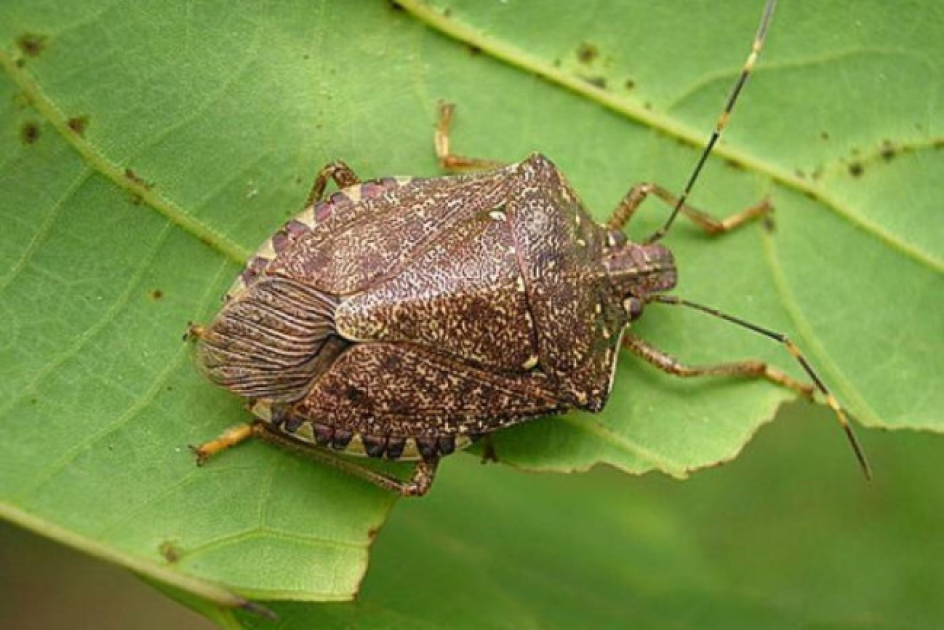
The spread of the brown marmorated stink bug in the dendroflora of Absheron and ecological control measures against it have been studied.
This was reported by Shameddin Gahramanov, PhD in Agrarian Sciences, an employee of the Dendrochronology and Plant Protection Laboratory at the Institute of Botany PLE of the Ministry of Science and Education.
Within the framework of the study, the phytosanitary condition of perennial trees and shrubs of significant economic importance in the dendroflora of Absheron was examined, and the spread, bioecological characteristics, and control measures against the brown marmorated stink bug (Halyomorpha halys Stal.) were investigated. To carry out the research, phytosanitary surveys were conducted on economically important trees and shrubs in the Absheron area, herbarium samples were collected from diseased and damaged plants and analyzed in the laboratory. As a result of the analyses conducted, the disease-causing agents and harmful insects found on the plants were identified.
During the observations, on 5–15-year-old young pine trees, pine aphid, pine scale insect, pine bark beetle, pine bark bug, and brown marmorated stink bug were recorded, as well as leaf spot, rust, and resinous canker diseases. The studies have shown that pine aphid, pine scale insect, pine bark bug, and brown marmorated stink bug cause serious negative effects on plant development by feeding on their cell sap.
The brown marmorated stink bug, selected as the main object of the study, has in recent years been assessed as a dangerous invasive pest widely spread not only on decorative trees and shrubs but also on various agricultural crops. Against the backdrop of climate change, the developmental characteristics and spread dynamics of this species have been monitored. Although some bioecological characteristics of the pest in the dendroflora of Absheron were studied in previous research, studies aimed at assessing its growth dynamics and spread have continued this year. The research was conducted at the Saray Experimental Station of the Institute of Botany PLE, as well as in the territory of Shuvalan Park in the settlement of Mardakan. Phytosanitary monitoring of various decorative trees and shrubs was carried out here. During the observations, nymphs of various ages and eggs of the brown marmorated stink bug were detected on young pine trees. As a result of laboratory analyses, the species of the pest was confirmed, and it was determined that the plants in the area were moderately infested.
During the research, special attention was also paid to studying the natural enemies of the pest. Predatory spiders and wasps were observed on infested pine trees, and photographs of them were taken to determine their species. As a result of the studies, it was determined that in the territory of Shuvalan Park on the Absheron Peninsula, the wasp (Trissolcus japonicus) and the predatory spider (Trichonephila clavata) play an important role in regulating the population of the brown marmorated stink bug.
It has been determined that the wasp parasitizes the eggs of the brown marmorated stink bug, preventing their development. The predatory spider, on the other hand, naturally contributes to reducing the pest's population by preying on its larvae and adult individuals. According to the scientists, protecting these beneficial entomophages and expanding the possibilities of their application as a means of biological control should be one of the main directions of future research.
It is noted that currently, chemical control methods are mainly used against the brown marmorated stink bug in our republic. In particular, preparations containing synthetic pyrethroids, applied during the developmental stage of the pest's young larvae, have high toxic effects and biological efficacy. However, the application of ecologically safe approaches is considered more appropriate in decorative landscaping areas, parks, and gardens.
The scientist stated that the application of sex pheromone traps against the brown marmorated stink bug, along with the protection of natural entomophages and their use in biological control, could lead to more effective and ecologically safe results in the future. Expanding scientific research in this direction is of great importance for preventing the spread of the pest both on the Absheron Peninsula and in other green spaces and agricultural areas of the country.













1730190904.jpg)